

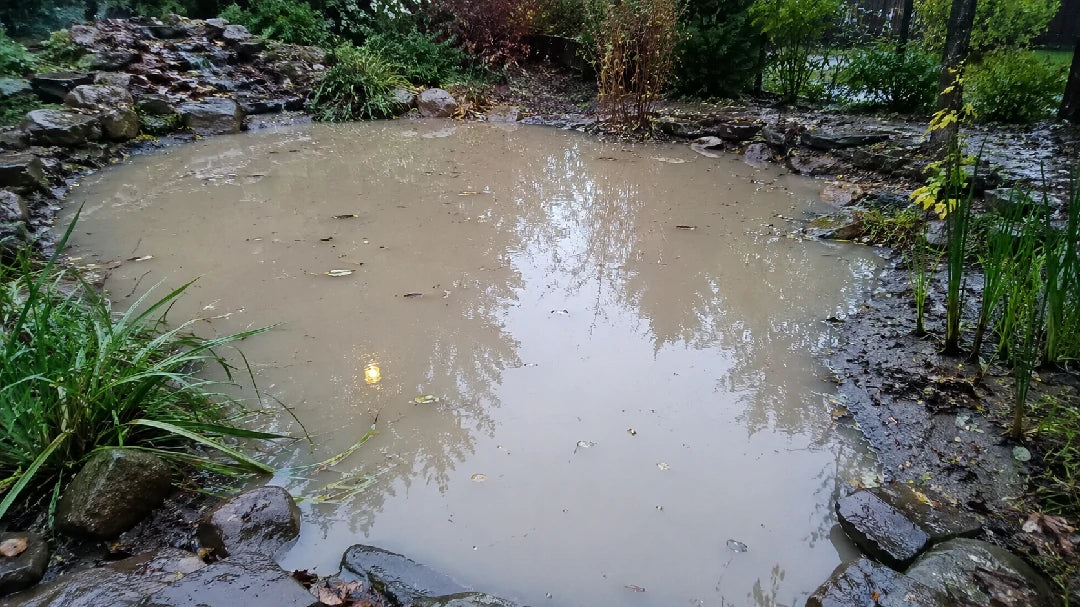
"April showers bring May flowers." While the phrase sounds poetic, for pond keepers, rain can quickly bring unpleasant issues to their ponds. As soon as the rain stops, pond water will turn muddy, and the clarity will be completely compromised. Fortunately, there is a solution to this problem. You just need to find an efficient way to clear cloudy pond water after the rain.
Causes of Muddy Pond Water After the Rain
There is nothing wrong with raindrops. It is what comes along with them that causes problems.

Runoff Brings Soil into the Water
The rain falls not just onto the ground. Some of it will run off, carrying tiny particles of soil and organic waste (leaves and plants) into the water. This phenomenon is known as runoff, and it is one of the main reasons why clouds form in ponds.
This type of soil particle suspension stays in the water for a very long time. That is why water will not become clear on its own.
Particles Create Cloudiness Through Scattering
Cloudiness appears in ponds not because of mud at the bottom of the water body. Tiny particles of dirt float throughout the pond and scatter (break apart) light beams (sun rays).
Rapid Changes in Water Chemistry
After the storm, water pH levels can suddenly decrease. In addition, organic waste increases and oxygen levels drop. Therefore, after rainfall, pond water is usually quite polluted.
That is why rainstorm pond maintenance is so crucial immediately after heavy rains.
How Clarifiers Make Cloudy Pond Water Worse Instead of Clearing It
When pond water becomes muddy, some people believe in magic chemicals. Chemical clarifiers are the most commonly considered solution to cloudiness.
Although they seem to work instantly, there are numerous problems with such pond treatments.
Clarifiers Hide the Problem Rather Than Resolve It
These substances make particles merge, causing them to sink. However, the water will remain polluted by soil, as the latter will not be removed.
When the water is disturbed, the particles will return to the top.
Can Affect Fish and Beneficial Bacteria
When a pond has been impacted by a rainstorm, it has already experienced rapid changes. Additional chemicals may add another layer of stress.
Therefore, fish and beneficial bacteria may be harmed by using clarifiers after a storm.
Quick Effect but Short-Lasting
While the effect seems instant, without proper filtration, the cloudy water will soon return.
Conventional wisdom advises patience and allowing water to clarify itself within several days. However, for many pond owners, waiting several days is quite stressful.
The Heavy-Duty Solution: How to Make Pond Water Crystal Clear in 10 Min with the SPF326?
The most effective solution is to remove the pollution rather than simply making it sink.
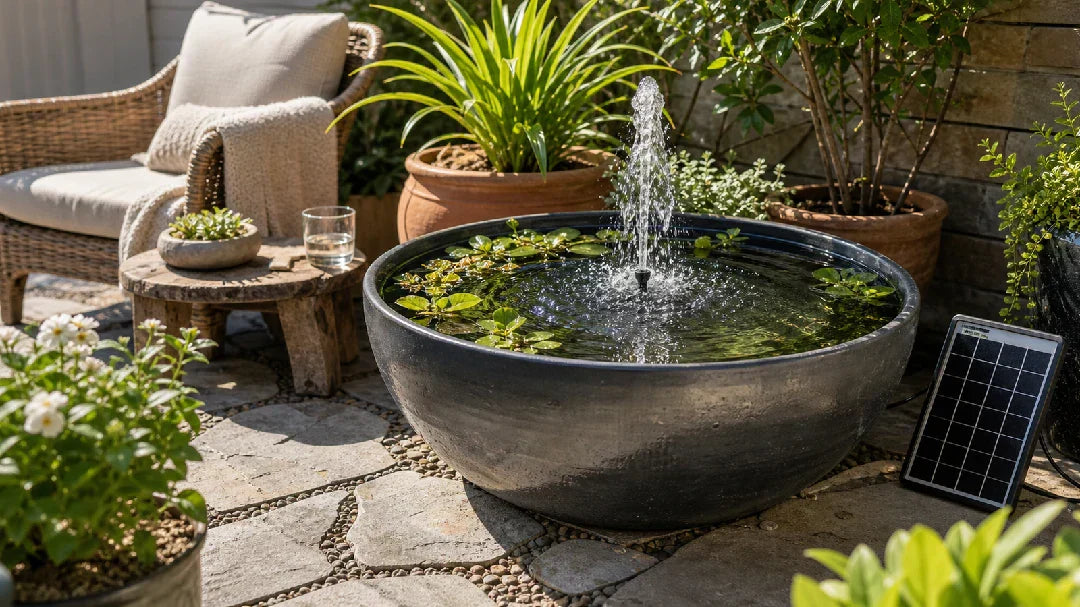
A strong pond filter system like the SPF326 Solar Pond Filter Fountain is specifically designed for this purpose.
It uses mechanical filtration, the process of physically removing particles from water.
Step 1: Submerge the SPF326

Submerging the device directly into the water initiates the filtering process.
As water passes through dense filters, particles become trapped. This process immediately starts eliminating the problem by removing suspended debris.
Step 2: Clean the Sponge

The filter fills up with pollution from the water and needs to be cleaned regularly.
- Remove the sponge.
- Rinse it using pond water.
- Do not use tap water, as chlorine may harm beneficial bacteria.
- Reinstall the sponge and continue filtration.
Step 3: Run a Fountain for Oxygen Exchange

When heavy rains occur, oxygen levels tend to fall.
Besides filtration, the system also includes a fountain feature. It brings water bubbles to the surface, helping to renew oxygen content.
Therefore, such a pond cleaning device is much more than a filter.
Why Using Mechanical Filtration Is More Efficient After Storms
During the rainy period, speed and stabilization are essential when it comes to pond water clarification.
By filtering water rather than chemically clarifying it, the process becomes more effective and longer-lasting.
You will often see noticeable results after several hours of filtration.
In addition, using a filtration system does not add stress to the pond.
This is a reliable way to manage murky ponds after a storm.
Conclusion
Heavy rain can cause pond water to turn cloudy very quickly. This occurs due to soil and organic waste carried into the pond and suspended throughout the water.
Chemical clarifiers can provide fast relief; however, they are not the best solution. Mechanical filtration proves to be more effective and sustainable.
Therefore, using an appropriate pond cleaning tool is one of the fastest ways to maintain a healthy pond after heavy rains.

SPF326 20W 280GPH Solar Pond Filter Fountain
$119.99
Clean and oxygenate your pond with this 20W solar pond filter pump. Eco-friendly 280GPH flow ideal for small to medium backyard water features.
FAQ
1. Why does my pond water turn cloudy after each storm?
Rainwater carries soil and debris into the pond.
2. What is the fastest way to clear cloudy water?
Use filtration systems to remove suspended particles quickly.
3. Is it safe to use clarifiers?
It is possible, but filtration is generally a better option.
4. How often do I need to clean my filter after the storm?
Several times a day during the first few days after severe weather.


Hinterlasse einen Kommentar
Alle Kommentare werden vor der Veröffentlichung geprüft.
Diese Website ist durch hCaptcha geschützt und es gelten die allgemeinen Geschäftsbedingungen und Datenschutzbestimmungen von hCaptcha.