

You put effort into arranging your garden pond, picking a proper mix of greenery—and suddenly realize that something's wrong: some leaves seem to be gone.
Roots are floating on the surface, creating a mess.
It is rather common and leads to a straightforward question: Do koi eat pond plants?
Yes, they definitely do—and sometimes more than you could expect.
In this article, we are going to discuss why it happens and what you can do to protect your greenery without affecting fish.
Why Koi Eat Pond Plants
It Is Their Natural Behavior
They are always looking for their dinner.
They slowly move along the bottom, exploring everything.
It is normal.
In the wild, koi eat insects, algae, and soft plant matter.
This means that they treat found plants as dinner when they appear in your pond.
It Is About the Digging
Koi do not simply eat.
They are constantly digging—moving stones and soil while looking for something delicious.
As a result, digging leads to plants getting torn out, although they are not necessarily eaten.
This explains why plants start floating with exposed roots.
When It Comes to Hunger
Undernourished fish start looking for additional sources of food.
In these conditions, edible plants become an attractive choice for koi.
It is especially true for soft plant species.
Warmer Temperature Equals More Activity
In the heat, koi become more active.
They start eating more, and movement becomes frequent.
It makes them more aggressive toward plants during spring and summer.
Plants That Fish Can Eat and Pond Plants Koi Won't Eat
Plants That Fish Can Eat
Soft plants and algae are easily destroyed.
For example:
- Water lettuce
- Water hyacinth
- Tender and/or thin-stem plants
Such plants are used as plants that fish can eat since koi enjoy them very much.

Pond Plants Koi Won't Eat
There are also more resistant plants.
They can endure some contact and movement; therefore, they do not attract fish.
These are great for long-term planting.
Examples include:
- Water lilies
- Lotus
- Reeds
- Durable underwater plants
Plants that can be moved without being easily damaged make a proper choice for a koi pond.
Why Proper Selection Is Important
Planting only soft species usually leads to trouble.
Mixing durable and soft plants allows you to achieve better results.
Durable plants remain stable, while softer ones can still be used in smaller quantities.
Choosing Proper Plants for a Koi Pond
Make Use of Different Layers
A balanced pond requires the presence of various plants.
For example, there should be:
- Floating plants providing shade
- Underwater plants producing oxygen
- Edge plants supporting pond construction
It allows you to maintain balance and increase the beauty of your garden.
Adding a solar fountain pump also helps keep water moving between different planting zones, preventing stagnant water while supporting healthier plant growth.
Protect Roots From Being Dug Up
Roots tend to be fragile.
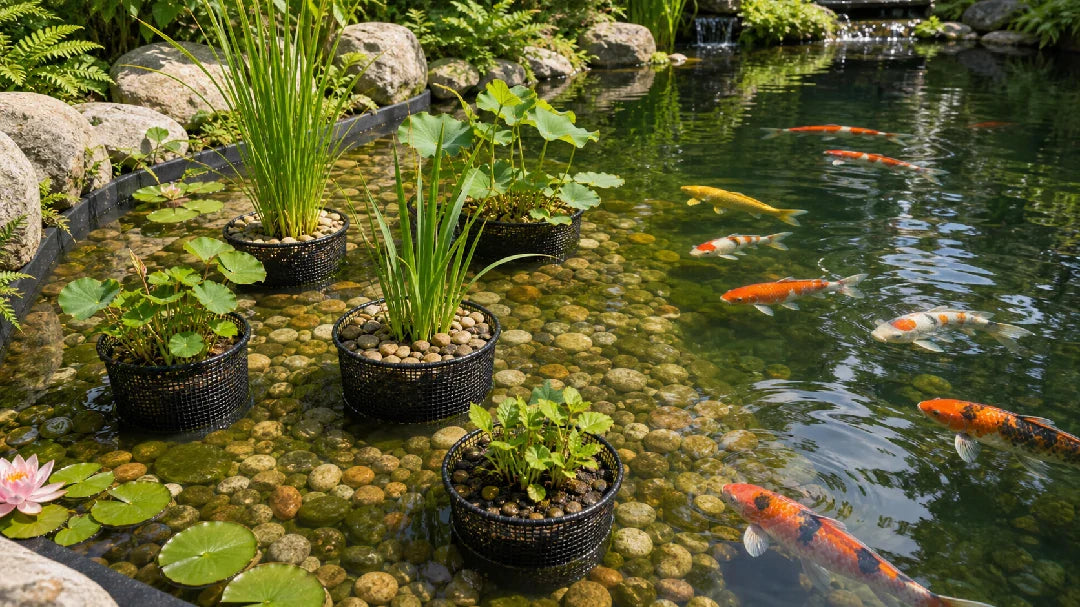
Using plant baskets helps.
Also, you can cover the soil layer with stones, preventing koi from digging.
Place Plants Properly
All parts of the pond are not the same.
Arrange sensitive greenery in quiet zones.
Avoid placing plants in spots where fish gather or where strong currents occur.
Effective Methods to Protect Your Pond Plants From Koi
Use Plant Baskets and Protective Coverings
Plant baskets prevent roots from being dug up.
Moreover, covering the soil with stones can discourage fish from disturbing plants.

Feed Koi Regularly
Hungry fish tend to be destructive.
Feeding your pets regularly is going to decrease their aggressive behavior toward plants.

Arrange Special Plant Areas
Try to separate plants from fish whenever possible.
Creating a shallow pond area or lifting plants slightly may help achieve that.

Improve Water Circulation
It makes fish less interested in digging.
As water moves around, no areas accumulate waste, making the environment cleaner.
You can consider various solutions to improve circulation [here]

Control Your Koi
Each pond is unique.
Observe your fish.
If some plants repeatedly get damaged, try changing their placement or replacing them with more durable species.
Conclusion
Maintaining coexistence between koi and plants requires some effort.
Fish actively move around and explore their surroundings, so there will be a few damaged plants from time to time.
However, using suitable plants for a koi pond and protecting them properly is a good way to solve the issue.
All it requires is knowledge and small improvements.
Choosing durable plants, protecting roots, and regular feeding all help.
Poposoap helps maintain proper water circulation and balance in your garden pond.

SPF326 20W 280GPH Solar Pond Filter Fountain
$119.99
Clean and oxygenate your pond with this 20W solar pond filter pump. Eco-friendly 280GPH flow ideal for small to medium backyard water features.
FAQ
1. Do koi eat pond plants permanently?
Usually, fish just occasionally nibble on plants when hungry.
2. Which plants are best to use in a koi pond setup?
Water lilies, lotus, and reeds.
3. Can you prevent koi from digging completely?
It is difficult to achieve; however, using plant baskets and covering soil helps.
4. Are there plants that are unappealing for koi?
Yes, there are such plants.

Hinterlasse einen Kommentar
Alle Kommentare werden vor der Veröffentlichung geprüft.
Diese Website ist durch hCaptcha geschützt und es gelten die allgemeinen Geschäftsbedingungen und Datenschutzbestimmungen von hCaptcha.