

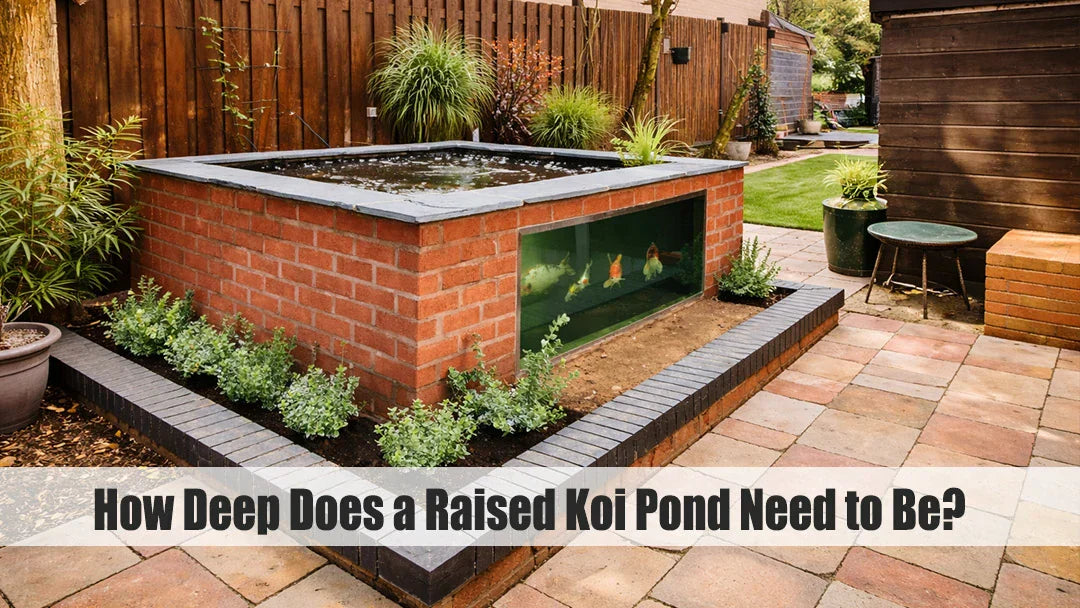
Ein erhöhter Koiteich ist einfach ein Teich, der teilweise oder vollständig über dem Bodenniveau angelegt wurde, mit Wänden aus Baumaterialien wie Stein, Blocksteinen, Holz oder Metall. Viele Menschen empfinden dies als ideal, da es eine klare Ästhetik bietet, kinderfreundlich ist und eine einfache Interaktion mit den Fischen ermöglicht.
Wo der größte Erfolg oder Misserfolg eines typischen erhöhten Koiteichs liegt, ist die Tiefe. Es ist mehr als nur eine Frage der Ästhetik. Die Tiefe eines Teichs wirkt sich direkt auf die Koi aus.
Kommen wir also zum Punkt. Wenn Sie Koi halten, muss die Teichhöhe mindestens 3 Fuß bzw. etwa 90 cm betragen, idealerweise etwa 4 Fuß bzw. etwa 120 cm, wenn Sie auf lange Sicht weniger Probleme haben möchten.
Warum Tiefe weitaus wichtiger ist, als man vielleicht denkt
Koi sind keine Flachwasserfische. Sie neigen dazu, ziemlich massiv und langlebig zu sein und unterscheiden sich sehr von Goldfischen.
In flachen Fischteichen, in denen die Fische mithilfe von Erdaufschüttungen wie Dämmen über den Wasserspiegel gehoben werden, zeigen Koi im Allgemeinen Anzeichen von Nervosität. Sie schrecken leicht auf und kommen nicht wirklich zur Ruhe. Dies schwächt ihr Immunsystem. Letztendlich entwickeln gestresste Fische Krankheiten, selbst wenn Wassertests gute Ergebnisse zeigen.
Ein weiterer Faktor, den der Teichliebhaber berücksichtigen sollte, ist die Teichtiefe, da dies dem Teich hilft, Wärme zu speichern. Ein oberirdischer Teich verliert schneller Wärme, da das Wasser an allen Seiten in direktem Kontakt mit der Umgebung steht. Im Sommer erwärmt sich das Wasser schneller, während es im Winter schneller abkühlt.
Ein weiteres Problem ist die Anwesenheit von Raubtieren. Das Erhöhen der Wände hindert Reiher, Waschbären oder Katzen nicht daran, an flache Bereiche zu gelangen. Die Tiefe ermöglicht es den Koi, sich außerhalb der Reichweite zu begeben.
Mit anderen Worten: Die Tiefe eines Teichs hat in keiner Weise mit Luxus zu tun. Tatsächlich geht es nur darum, Ihren Koi ein Sicherheitsnetz gegen alle möglichen Fallstricke zu bieten.
Was bestimmt die optimale Tiefe eines erhöhten Koiteichs?

Das Klima steht an erster Stelle
Wenn Ihre Winter mild sind und Teiche selten gefrieren, könnte eine Tiefe von 3 Fuß (ca. 90 cm) akzeptabel sein. Wenn Ihre Winter lang und kalt sind, sind 4 Fuß (ca. 120 cm) weitaus empfehlenswerter. Koi verbringen den Winter am Boden des Teichs, wo die Temperaturen weitaus eher stabil bleiben.
Ein erhöhter Teich gefriert schneller als ein in den Boden eingelassener Teich. Es gibt kein Erdreich um das exponierte Wasser, das für die gleiche Art von Isolierung sorgt. Allein das ist ein guter Grund, tiefer zu bauen.
Anzahl und Größe der Fische
Nur ein paar kleine Koi könnten Sie glauben lassen, dass ein flacher Teich ausreicht. Sobald sie wachsen, wird er nicht mehr ausreichen.
Koi sind ziemlich „verschwenderisch“. Wenn Fische an Größe zunehmen, wird der Wasserraum in Teichen zu einer Herausforderung. Das tiefere Anlegen des Wassers erhöht die Kapazität, ohne viel Platz im Garten zu beanspruchen.
Filtration und Zirkulation
Tiefe ist nur in Kombination mit einer guten Filterung effektiv. Ein tieferer Teich gibt den Filtern mehr Zeit, das Wasser aufzubereiten, aber Filter sind dennoch notwendig.
Viele Entwürfe für erhöhte Koiteiche beinhalten Merkmale wie Wasserfälle und Springbrunnen. Diese Elemente sehen nicht nur gut aus. Artikel wie das Teichbrunnen-Filter, Wasserfall & Licht 3-in-1-Set und der 20W 280GPH Solar-Teichfilter-Springbrunnen von Poposoap können bei der Filterung helfen und eine Stagnation der Teichoberfläche verhindern.
Ohne Strömungen kann es für einen tiefen Teich schwierig sein, die Wasserqualität aufrechtzuerhalten.
Optionen für erhöhte Teichwände nach Tiefe

Die Art der Mauer, die Sie errichten, bestimmt die maximale Tiefe, die Sie erreichen können. Hier ist ein Vergleich gängiger Baumaterialien für erhöhte Teichwände:
- Betonblock oder gegossener Beton – Das beste Preis-Leistungs-Verhältnis. Kann eine Tiefe von 4 bis 5 Fuß (ca. 120–150 cm) bewältigen.
- Ziegel oder Stein – Attraktiv und langlebig. Geeignet für Höhen von 3 bis 4,5 Fuß (ca. 90–135 cm), abhängig von der Bauqualität.
- Metall- oder Stahlpaneele – Modern und stabil. Perfekt für tiefe Designs, wenn sie korrekt installiert werden.
- Bahnschwellen/Holzbalken – Häufig bei Heimwerkerprojekten verwendet, unterstützen aber nicht viel Tiefe. Sollten auf maximal 2 bis 3 Fuß (ca. 60–90 cm) begrenzt bleiben.
Wenn das Ziel die Haltung von Koi ist, sollte jede Teichumrandung, die die Tiefe auf unter 3 Fuß (90 cm) begrenzt, sicherlich ein Warnsignal sein.
Tiefe allein ist nicht das ganze Design
Dies ist ein Punkt, den viele Menschen falsch verstanden haben.
Nur weil das Wasser im Teich tief ist, bedeutet das nicht, dass das Design des Teichs gut ist. Tiefe ist nur ein Aspekt des Designs.
Wenn der Teich flach und schmal ist, ist der Schwimmbereich begrenzt. Koi benötigen sowohl horizontalen Schwimmraum als auch Tiefe. Wenn der Teich scharfe Ecken oder einen steilen Abfall aufweist, könnten die Fische Verletzungsgefahren ausgesetzt sein.
Gute Designs für erhöhte Koiteiche verbinden Tiefe mit Größe, bieten ein glattes Inneres und eine stetige Wasserzirkulation. Fische sollten natürlich schwimmen können, ohne sich umdrehen zu müssen oder eine Wand zu berühren.
Tiefe sollte als Versicherung betrachtet werden, nicht als Allheilmittel.

Nützliche Tiefenbereiche, die wirklich funktionieren
Diese Bereiche bewähren sich in der praktischen Erfahrung:
- Absolutes Minimum: 3 Fuß (90 cm)
- Empfohlen für langfristige Koihaltung: 4 Fuß (120 cm)
- Kaltes Klima oder große ausgewachsene Koi: 4,5–5 Fuß (135–150 cm)
Die Vergrößerung der Tiefe ist nicht schädlich, erhöht aber die Kosten und die Belastung der Struktur. Das Ziel ist es, Stabilität zu erreichen, nicht die maximale Tiefe.
Fazit
Was ist also die Tiefenanforderung für einen erhöhten Koiteich?
Damit sich Koi wohl und sicher fühlen, beträgt die minimale Teichtiefe 3 Fuß (90 cm), wobei 4 Fuß (120 cm) die überlegene Wahl sind. Tiefe schützt den Teich vor extremen Temperaturen, Raubtieren, Stress und Problemen mit der Wasserqualität – vorausgesetzt, eine Qualitätsfiltration ist vorhanden.
Wenn Sie sich noch in der Planungsphase befinden und Inspiration suchen, die nicht nur auf Maßen basiert, dann könnte Ihnen dieser Artikel helfen, Konfigurationen in Betracht zu ziehen, die Raum und Tiefe in Einklang bringen: 6 Einzigartige Ideen für erhöhte Teiche in kleinen Gärten

4′ x 4′ Teichdekor-Set | 3-in-1 Filter, Wasserfall & Licht
269,00 $
4′ x 4′ Teichdekor-Set mit Filter, Wasserfall aus Edelstahl 304 und RGB-Teichleuchte. Einfach zu installieren, perfekt für Koiteiche und Wasserspiele im Garten.
Häufig gestellte Fragen
Kann ich für einen erhöhten Koiteich zu tief graben?
Ja. Teiche mit größeren Tiefen benötigen robustere Wände.
Ist tieferes Teichwasser zwangsläufig besser?
Nicht unbedingt – die Tiefe sollte gut mit der Breite des Teichs und den Kosten des Filtersystems korrelieren.
Tiefe oder Kapazität – Was ist wichtiger?
Beides ist wichtig. Tiefe ist wichtig für die Stabilität, während Kapazität wichtig für die Verdünnung von Abfallstoffen ist.
Sind erhöhte Fischteiche riskanter als in den Boden eingelassene Teiche?
Sie könnten es sein, wenn sie zu flach gebaut und nicht ordnungsgemäß isoliert sind.
Können Goldfische in flacheren Teichen als Koi gehalten werden?
Ja. Goldfische sind toleranter gegenüber flachem Wasser als Koi.



Hinterlasse einen Kommentar
Alle Kommentare werden vor der Veröffentlichung geprüft.
Diese Website ist durch hCaptcha geschützt und es gelten die allgemeinen Geschäftsbedingungen und Datenschutzbestimmungen von hCaptcha.