

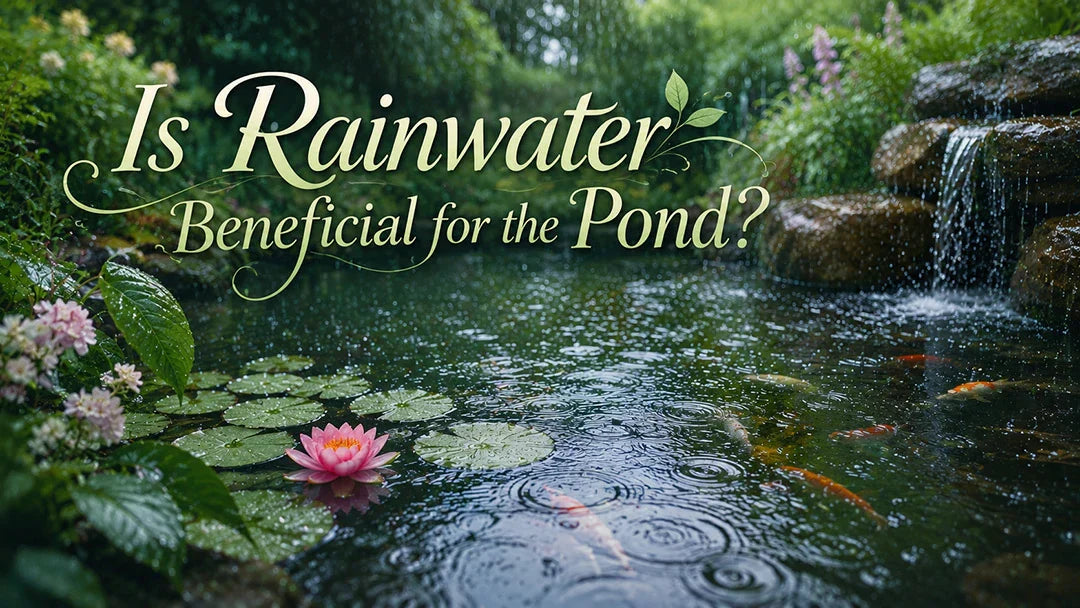
Lassen Sie uns die Auswirkungen von Regenwasser genauer besprechen.
Was ist in Regenwasser enthalten?
Die folgenden Substanzen können in Regenwasser gefunden werden:
- Staub aus der Atmosphäre
- Schadstoffe aus der Atmosphäre
- Stickstoffverbindungen
- Kleine Metallpartikel im Regenwasser, insbesondere in städtischen Gebieten
Wenn Regenwasser über die Dächer läuft, bevor es in den Teich gelangt, kann es auch die folgenden Verunreinigungen mit sich führen:
- Vogelkot
- Schmutz
- Rückstände vom Dachmaterial
Daher wird empfohlen, kein vom Dach gesammeltes Regenwasser in den Koiteich gelangen zu lassen.
Beeinflusst starker Regen den Gehalt an gelöstem Sauerstoff im Koiteich?
Dies ist eine wichtige Frage.
Leichter Regen kann eine verstärkte Wasserzirkulation an der Wasseroberfläche verursachen. Die erhöhte Wasserzirkulation kann die Rate des Gasaustauschs von der Atmosphäre in das Wasser verbessern und somit den Gehalt an gelöstem Sauerstoff erhöhen. Starker Regen kann jedoch die folgenden Probleme verursachen.
Wenn Regenwasser Blätter, Erde oder andere Verunreinigungen in den Teich spült, beginnen Bakterien, diese abzubauen. Der Zersetzungsprozess verbraucht den gelösten Sauerstoff im Wasser.

Laut der U.S. Environmental Protection Agency kann Folgendes mit den Fischen im Wasser geschehen, wenn der Gehalt an gelöstem Sauerstoff sinkt. Ein niedriger Gehalt an gelöstem Sauerstoff kann bei Fischen Stress verursachen oder zum Tod führen.
Reduziert starker Regen also den Gehalt an gelöstem Sauerstoff im Koiteich? Die Antwort lautet ja.
Die Koi in den Teichen sind extrem empfindlich gegenüber jeglicher Instabilität im Wasser. Die Fische können unter jeder Wasserbedingung leben, solange die Veränderungen im Wasser langsam erfolgen. Plötzliche Veränderungen können jedoch zu Instabilität im Wasser führen und somit die Fische beeinträchtigen.
Welche Maßnahmen können ergriffen werden, um den Koiteich vor Regenwasser zu schützen?
Man kann zwar nicht verhindern, dass Regenwasser in den Teich gelangt, aber es können einige Maßnahmen ergriffen werden, um das Wasser vor dem Regen zu schützen.
Den Abfluss verhindern
Der erste Schritt, um das Eindringen von Regenwasser in den Teich zu verhindern, besteht darin, die Ränder des Teichs anzuheben, indem man sanfte Gefälle anlegt.
Vermeiden Sie es, einen Teich an einem Ort anzulegen, der der tiefste Punkt in Ihrem Garten ist.
Eine starke Filterung unterstützen
Filterung ist wichtig, besonders nach einem Sturm. Ein mechanisches Filtersystem entfernt Partikel, während ein biologisches Filtersystem nützliche Bakterien bereitstellt, die beim Abbau von Abfallprodukten helfen.
Eine gleichmäßige Zirkulationsrate ist entscheidend, um ein konstantes Sauerstoffniveau zu gewährleisten. Ein zuverlässiges Filtersystem, wie ein AC-Teichfilter, ist wesentlich, um nach einem Sturm ein ausgeglichenes System zu bieten. Weitere Informationen finden Sie unter diesen Optionen: Poposoap AC Teichfilter.
Ein starkes Filtersystem ist unerlässlich, um eine langfristige Lösung für einen Teich zu bieten.
Bei Bedarf die Belüftung erhöhen
Beobachten Sie Ihre Fische nach einem Sturm genau. Wenn Ihre Koi an die Oberfläche schwimmen oder ihre Kiemenbewegung schnell ist, ist dies ein Zeichen dafür, dass der Sauerstoffgehalt niedrig ist.
Die Erhöhung der Belüftung, beispielsweise durch den Einsatz einer Luftpumpe oder eines Springbrunnens, ist entscheidend, um den Sauerstoffgehalt zu erhöhen.

Wasserbedingungen testen
Nach einem Sturm ist es wichtig, die Wasserbedingungen zu testen, um ein ausgeglichenes System zu gewährleisten. Folgendes sollte getestet werden:
- pH-Wert
- Ammoniak
- Nitrit
- Nitrat
Wenn einer dieser Werte abweicht, ist es wichtig, einen kleinen Teilwasserwechsel durchzuführen, anstatt einen vollständigen Wechsel. Ein vollständiger Wasserwechsel wird nicht empfohlen, da dies einen erneuten Schock für Ihre Fische bedeutet.
Fischverhalten beobachten
Das Verhalten der Fische ist ein hervorragender Indikator dafür, was in Ihrem Teich vor sich geht.
Wenn Ihre Fische eines der folgenden Verhaltensweisen zeigen, ist dies ein Zeichen dafür, dass etwas nicht stimmt:
- Angelegte Flossen
- Scheuern
- Lethargie
- Luftschappen an der Oberfläche
Wenn Ihre Fische Verhaltensänderungen zeigen, ist dies ein Zeichen dafür, dass Ihr Teich aus dem Gleichgewicht geraten ist, insbesondere nach Regen.

Fazit
Ist Regenwasser also gut für Teiche?
Regenwasser ist gut für Teiche, da es natürlich ist; es ist jedoch nicht unbedingt sicher für Koiteiche. Regenwasser auf der Teichoberfläche führt zu plötzlichen Veränderungen der Temperatur, des pH-Werts und des Sauerstoffgehalts.
Die einzige Anforderung für Koiteiche ist Stabilität; Koifische benötigen nicht zwingend Wasser von höchster Qualität, sondern vielmehr eine konstante Qualität.
Ein gut gestalteter Koiteich mit einem AC-Filter wie dem Poposoap AC Teichfilter stellt sicher, dass der Koiteich auch während Regenfällen sicher bleibt. Um mehr über Regenwassersammelsysteme und Teiche zu erfahren.
Bei der Sicherheit von Koifischen geht es nicht darum, den Regen zu verhindern, sondern den Wandel zu bewältigen.

P3203 20W 280GPH Solar-Teichfilter-Springbrunnen
119,99 $
Reinigen und belüften Sie Ihren Teich mit dieser 20-W-Solar-Teichfilterpumpe. Umweltfreundlicher 280GPH-Durchfluss, ideal für kleine bis mittelgroße Wasserspiele im Garten.
Häufig gestellte Fragen
1. Ist Regenwasser gut für Teiche, wenn es in kleinen Mengen fällt?
Das Regenwasser ist sicher für Koiteiche, wenn es leicht regnet; Probleme entstehen jedoch, wenn es stark regnet.
2. Reduziert starker Regen den Gehalt an gelöstem Sauerstoff im Koiteich?
Ja, das tut er, insbesondere wenn der Regen mit Abfluss einhergeht, der organische Stoffe mit sich führt, die den Sauerstoff im Teich verbrauchen.
3. Sollte man das Wasser im Teich vollständig wechseln?
Nein; es ist ratsam, nur einen kleinen Teil des Wassers zu wechseln, anstatt das gesamte Teichwasser.
4. Kann man das Regenwasser für den Koiteich sammeln?
Ja, aber nur mit einer ordnungsgemäßen Aufbereitung und Filterung des Wassers.


Hinterlasse einen Kommentar
Alle Kommentare werden vor der Veröffentlichung geprüft.
Diese Website ist durch hCaptcha geschützt und es gelten die allgemeinen Geschäftsbedingungen und Datenschutzbestimmungen von hCaptcha.